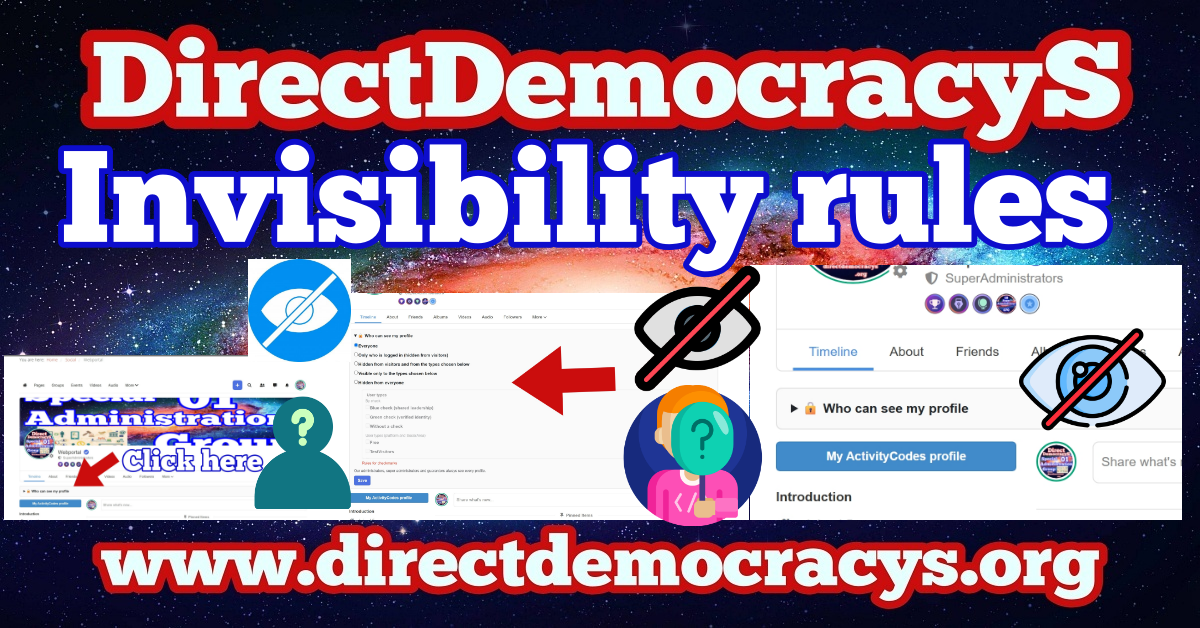
DirectDemocracyS guarantees all its users anonymity and even invisibility.
A brief explanation of the requirement to register with our system for anyone who wants to contact us, receive direct and concrete support, or carry out activities with us.
DirectDemocracyS presents itself to everyone with hundreds of highly detailed, public informational articles. It's only right, not to mention logical, common sense, good manners, and respectful, that anyone who wants to interact with us introduce themselves, tell us who they are, tell us a little about themselves, their country of origin, and the reasons why they're contacting us, whether they want to join us or remain an external contact. Naturally, these presentations are encrypted, stored in secure areas, and can only be partially viewed by humans and machines, so that anyone who knows your real name won't know your username, and vice versa.
Your username on DirectDemocracyS is used to identify yourself, with very few obvious exceptions: our political representative profiles, which use their real first and last name written in their own language (exactly as it appears on their identity documents), with the addition of the letters pr at the end of their first and last name; or our official representatives, who can have different usernames—even geographic coordinates—with the addition of the letters or at the end of their username , depending on their activities and according to very detailed implementation rules. Therefore, our personal profiles are identified by their username, while representative profiles (political and official) are public figures who can and must be identified at various levels: micro-group, local (from our smallest to our largest organization), or national, continental, or international.
Anonymity is guaranteed by a username chosen by everyone who logs into our system, according to our rules. It's very simple: you can choose a nickname that's unrelated to your real name and surname, or, if you prefer, our system will automatically choose it based on the primary country selected by the person logging in. This username is the most secure, guarantees anonymity for your personal profile, and begins with the ISO code for your primary country, followed by a random string that makes it impossible to guess your real name and surname.
As we've already explained, you use your username in all our activities, with the exception of the three stages of identity verification: compatibility with our system, professional skills, and final identity verification. These three stages consist of three video calls with members randomly selected from randomly selected groups. They verify and assess each person's compatibility with DirectDemocracyS, assess their professional skills with all necessary checks and wherever required (without telling anyone you're joining us), and, with the third, final identity verification, issue you a unique code so you can join us. During these three video calls, none of our members will know your username, and you must never disclose it. Our members carry out their respective activities without knowing whether you're joining us or for other reasons, such as collaborating externally. After the subsequent stages of registration and activation of your personal profile, none of the members you meet in the video call will have further contact with you, but you will be assigned as contacts to the person who officially invited you.
Explanation of the username with ISO of a main country in all other countries
Our system, regarding the primary and secondary countries, takes into account three requirements: nationality, country of citizenship, and country of habitual residence (more than 6 months per year, while countries where you reside less than 5 months per year fall into another category). Since there are so many cases, our system also asks you, of course, whether you have the right to vote in the respective countries (the primary and secondary ones) and potentially run for office. Therefore, each of our users can potentially use their personal profile and user type in an unlimited number of countries, although we recommend no more than five countries (one primary, for which you can use the ISO code, and four secondary countries, for which you can use the same personal profile). Initially, we recommend starting with just the primary country and then, based on a simple request using our specific form, you can request access to all secondary countries, one at a time, with integration periods to avoid any potential problems.
Explanation of anonymity for official invitations
To ensure no one is left behind and to provide direct support and practical assistance to all our new users, each of them, based on their geolocation (i.e., their exact address in their primary country), will be automatically matched with our official member closest to their place of residence. Immediately after registering with our system at this link:
https://free.directdemocracys.org/utility/present-yourself?view=present
After filling out all the required information, choosing your username based on the rules and recommendations above, and entering a temporary password (different from the one you choose in the registration form and which you will use to access our reserved areas), we recommend you visit this link:
https://free.directdemocracys.org/social/groups/nearby
where you will find our group closest to you (do it when you are at home).
Contact one of our official organization's groups directly, ensuring it has at least a green checkmark (indicating smaller local groups with fewer members) or, preferably, a blue checkmark (indicating local groups that have become official organizations, with at least 31 members). Always choose the one closest to your home. Under no circumstances should you choose groups that don't have green or blue checkmarks. Never choose national, continental, or international groups, but only local ones within the smallest geographic subdivision. Approve geolocation so you don't have to manually search for the groups closest to your area, or always search for the one closest to your home.
A brief historical explanation: while in the initial phases, all new users were directly placed in our international groups, in subsequent phases—to implement local autonomy with the same rules, methodologies, instructions, and motivations—all new users were placed first in continental groups, then in national groups, and finally, in the current phase, in local groups, always in the smallest geographical subdivision. If there are already facilities near your home, you will be placed in the nearest micro-group. The motivation is also to encourage widespread development throughout the region and reward the first "courageous" ones who joined us before others, who thus have the opportunity to join our official groups and organizations (which, as already explained, are groups that have reached or exceeded 31 members).
For the name of the activity, choose: matching with another user . Sponsors, super administrators, administrators, or other members responsible for responding to messages from the local official group or organization you've contacted will perform a specific task: searching for the group or organization closest to your address or the prospective user's geolocation, contacting the relevant group and starting the application process for the new member.
Subsequently, based on various steps, you will be matched with a local group or microgroup and a randomly selected member from among those with the fewest users connected as friends/contacts in the social area of our websites and platforms. The system chooses randomly: the selected person is notified via an internal message in the social area and, for security, also via email. If they accept a new connection, they will receive a number of points set in ActivityCodes based on our implementation rules (group members who decline automatically lose a certain number of points).
The system must always choose among the members with the fewest connected users, also taking into account the user type of your contacts based on the complete list of types for each phase. This random matching will also allow you to meet people who live near you (you can adjust the settings by age, gender, and various characteristics). However, the method we recommend to everyone, and it's also the simplest, is another: if you know someone who is already an official member (and therefore a collective owner of our entire system), it's best to be matched directly with them.
To do so, after introducing yourself to our system via the link above and checking the group closest to your home, you will need to contact our official member directly by typing their username (never write their real name and surname, just their username) at this link: https://free.directdemocracys.org/utility/activity-group/request-the-authorization/write?view=write and requesting an official invitation, which can be sent to you via email or by sharing their unique official link for the registration form, which will automatically match you with them immediately after activating your personal profile.
For those who are already our users and want to participate in this activity by inviting relatives, friends, neighbors, work colleagues, school colleagues, or acquaintances, simply copy and share your personal and unique invitation code (which directly matches the new user to yourself), available at this link:
https://www.directdemocracys.org/social/friends/invite
You can also send an invitation directly via email containing the link to join us, which you can use for family, friends, and neighbors, thus avoiding sharing your unique registration code with strangers. Anyone with the code, after verifying their identity (required before completing the registration form), can join us and, via the unique link or email invitation, will be automatically and immediately added as a friend/contact of our member.
The higher types of users with green ticks or preferably blue ticks (which offer greater potential) will be able to manage a variable and gradual number of invitations, completed by our system with random matches (at random) that will take into account the number of contacts/friends of each of our previous users and the types of their respective contacts, thus ensuring fairness and gradualness.
Warning: Anyone who makes their unique link public to strangers or acquaintances must always remind them not to share the link they receive with anyone. If links offer points, those who abuse them by having too many people register (even strangers and those not matched by our system) just to accumulate points risk losing them all. Similarly, anyone who uses someone's unique link to register irregularly or incorrectly—that is, without the user's official invitation or without the random matching managed by the system via ActivityCodes—could be blocked, lose points, or even lose their accumulated points.
From your first login, you can communicate encrypted and confidentially on our platforms and do many activities together.
Not everyone joins official groups and organizations
Only two types of users have different access to our groups and official organizations at the local level (geographic, territorial, administrative and electoral):
- Verifieds: must be current with their annual dues, perform volunteer work, and maintain a minimum presence on our platforms according to our rules. As registered users with verified and guaranteed identities—who contribute financially by regularly paying annual dues (with discounts and extended deadlines for those with lower incomes) and perform ongoing volunteer work (at least 20 minutes a day, in one or more logins, or alternatively at least 120 minutes a week)—they make our enormous mechanism work. Consequently, they are automatically part of our truly and fully shared leadership and have the right to vote (bindingly within our system) in the voting groups associated with all our local and micro-groups. These voting groups elect electors at the local, national, continental, and international levels, who decide on all fundamental, important, and moderately important issues. They also vote in our closed online primaries for the selection, nomination, evaluation, and selection of our candidates to run in the real elections.
- Official members: These are our collective owners and therefore have much more potential than lower-level users. While they are part of the shared leadership, they perform many activities and vote in separate groups, electing electors in secret groups (visible only to those invited) and private groups where they manage visible and invisible pages, events, videos, audio, and—if they wish, in addition to our political organization—can jointly conduct investments and business. They are the first type of user entitled to request (and, if they meet all the requirements, be authorized to create) various types of profiles, such as partially public profiles for political or official representatives, and even system profiles for our many joint projects.
Our decisions are made within the official groups and organizations in our social area: through shared leadership with verified users and collective ownership with official members. In the event of a tie, the other types of management or control users will decide. Should a further, very rare, tie between the various types occur, our administrators and super administrators will be asked for a decisive opinion, and in the event of further deadlock, the votes of our guarantors will be decisive.
Lower-tier and free users, based on specific implementation rules for each category, can be matched with existing users directly via Activity Codes (either randomly or with people they know). However, the system will place them in groups reserved for these categories and not in local groups, nor in micro-voting groups for the "Verifieds" category (shared leadership and binding vote), nor in official groups and micro-groups reserved for official members (collective ownership, activity, management, and control of the system with binding votes everywhere).
The DirectDemocracyS system favors those who regularly volunteer and those who contribute to the system's self-financing by paying annual dues (with a single initial payment for those with lower incomes, extending the duration from 1 to 3 or 4 years). Therefore, there is no discrimination whatsoever; on the contrary, we always help those in greatest need. Those with higher incomes may, if they wish, make free and voluntary donations to support the project, exclusively through the donation forms on our websites.
We do not and will never conduct fundraising outside of our platforms. Our national and local organizations will be able to receive, declare, manage, and control all sums received as state and local contributions to political parties, accurately documenting every single cent spent to the state and the various local donor agencies. Annual dues and private donations, however, can only be made internationally, to then reward our top members, purchase technology, cover current expenses, and support other needs managed by our groups (which all official members can join according to very detailed implementing rules).
How to make your profile invisible (personal or otherwise)
In the social area—accessible by clicking on Social in the main menu—select the Account item in the management menu and click on My Profile .
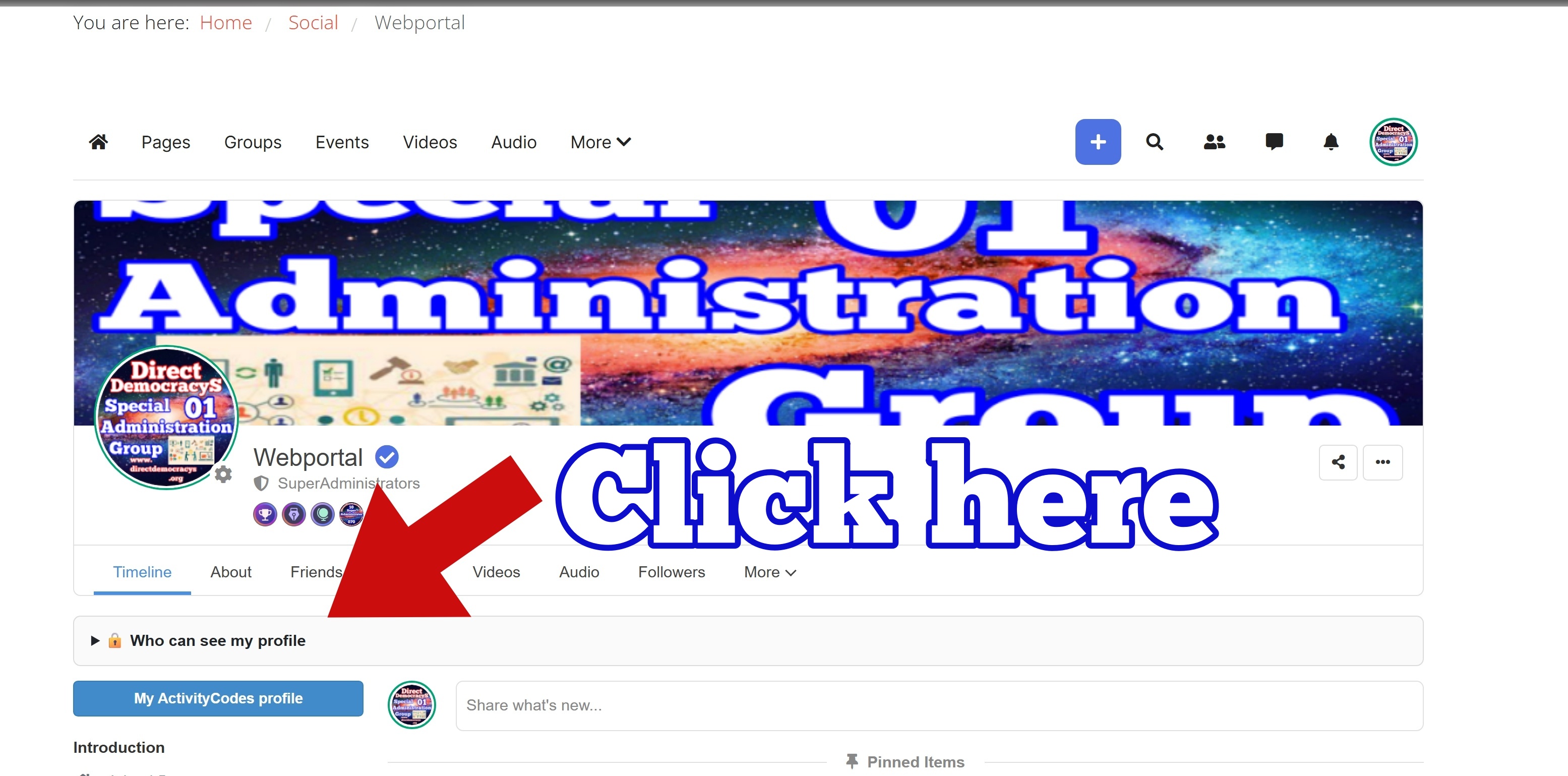
Scrolling down, the words "Who can see my profile" will appear ; clicking on it will allow you to select the various options:
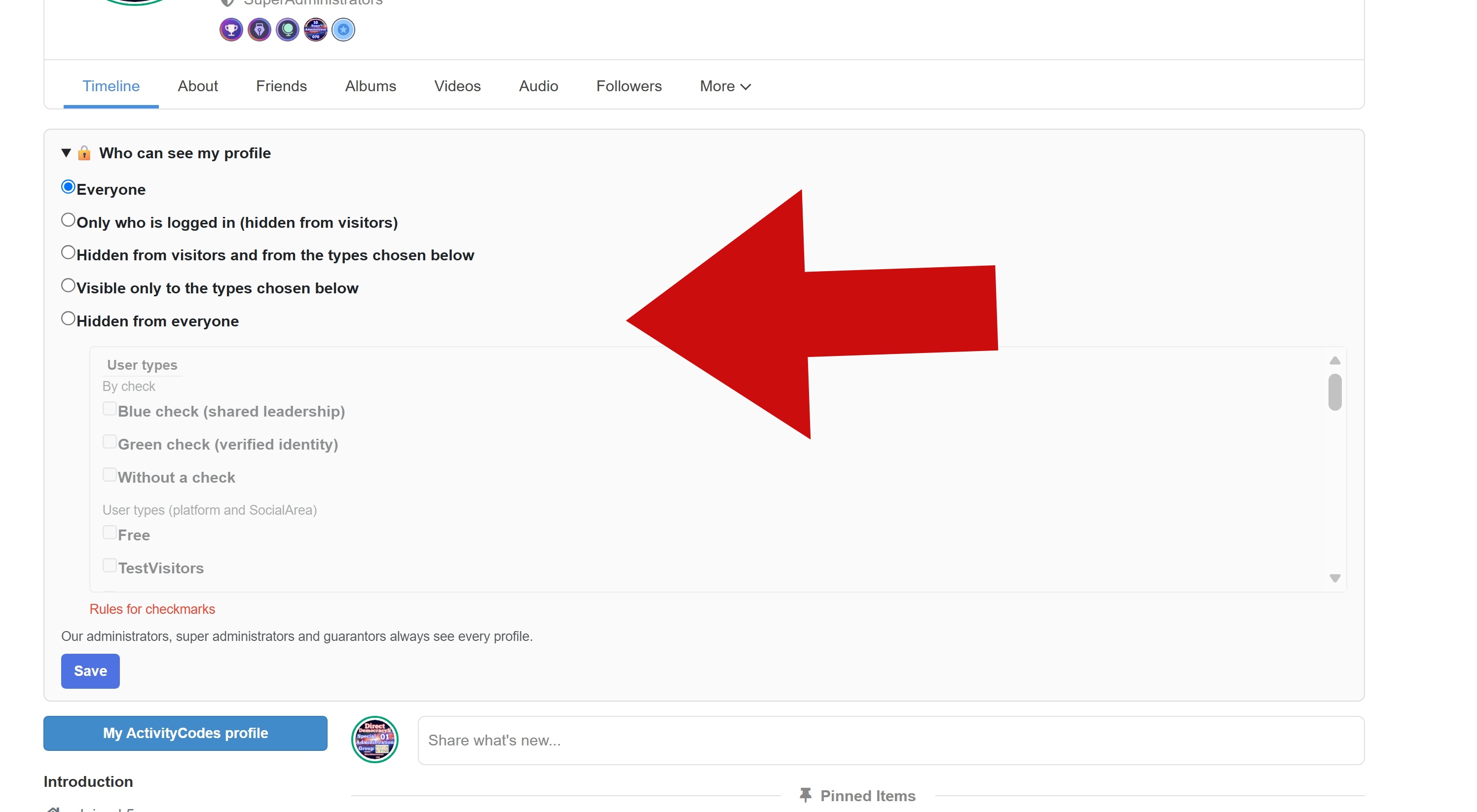
- Everyone: This means that your personal profile is visible to all users and visitors to our website.
- Registered users only: Makes your personal profile visible only to our registered users, hiding it from visitors.
- Hidden from visitors and selected users: Makes your profile invisible to all visitors and specified user types. Check all the options you want to be invisible to.
- Visible only to selected types: Makes your profile accessible only to selected user types. Check all the ones you want to be visible to.
- Invisible to everyone: This option completely hides your personal profile from anyone. Obviously, there are security groups and specific user types who can see the profile's existence, various activities (partially visible based on previous settings, even to those in the same groups), your username, and only in justified, authorized, and documented cases, your real name and surname (generally to add people to unwanted lists), or for salary payments (if you have bank accounts outside of our system), prizes, and to send paper documents. In certain cases, your home address or mailbox, along with related data, may also be visible. Obviously, anyone who sees your username does not see your real name and surname, and anyone who sees your real name and surname does not see your username, to ensure continuous anonymity.
The ability to be completely invisible, according to one's wishes, combined with the guarantee of anonymity, are exceptional security measures; they work perfectly for those who wish to peacefully carry out various activities without being disturbed. Anonymity and invisibility are not opportunities to engage in despicable activities, which, if visible, or worse, invisible, are not permitted , are not possible, and will be severely punished.
a. To accept full responsibility for the comment that you submit.
b. To use this function only for lawful purposes.
c. Not to post defamatory, abusive, offensive, racist, sexist, threatening, vulgar, obscene, hateful or otherwise inappropriate comments, or to post comments which will constitute a criminal offense or give rise to civil liability.
d. Not to post or make available any material which is protected by copyright, trade mark or other proprietary right without the express permission of the owner of the copyright, trade mark or any other proprietary right.
e. To evaluate for yourself the accuracy of any opinion, advice or other content.