
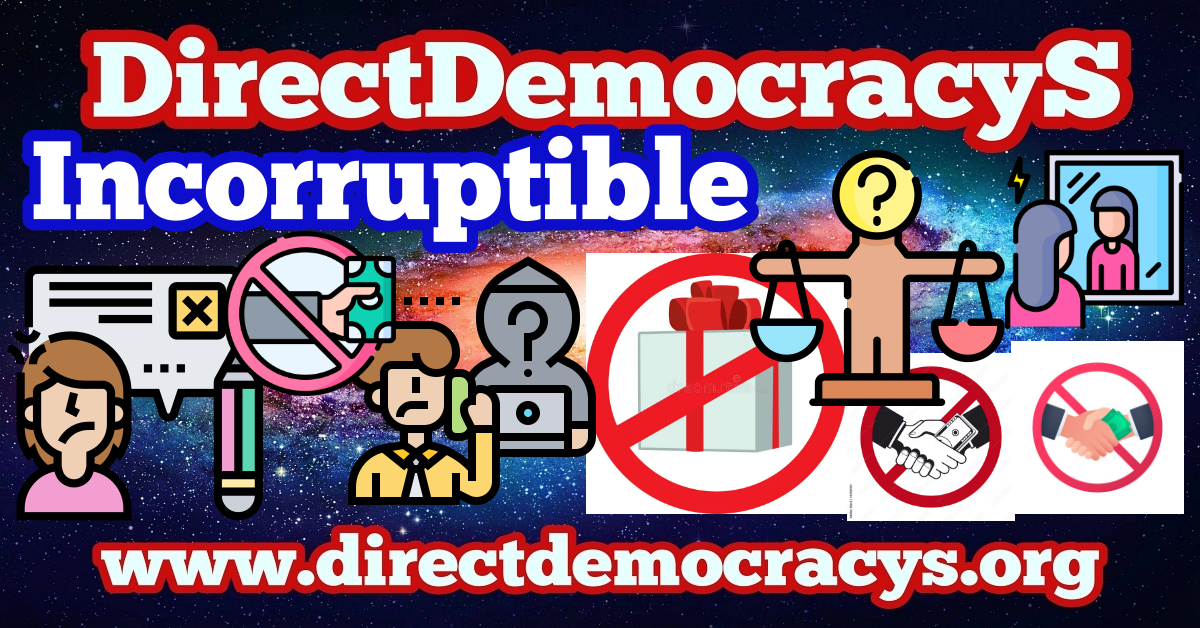
One of the greatest flaws of us human beings is that we are almost all easily corruptible.
From this simple and undeniable phrase, we created DirectDemocracyS, seeking solutions to this scourge that makes our lives worse.
Almost all of them come at a price, and all systems, except ours, don't do a good job of preventing these despicable behaviors.
It would be easy to trivialize by saying: politics is all corrupt. Generalizing is always wrong, and we try and succeed in never doing so. In many of our sentences, we add the words: some (some are corrupt), often (often there are corrupt people), in certain cases (in certain cases there are corrupt people), or almost all (almost everyone is corrupt). This way of communicating allows us to avoid offending the few incorruptible people, while still analyzing society in a fair and equitable manner.
We find it profoundly wrong to distinguish between petty corruption and grand corruption, because both are wrong. It's like saying: in that war, only a few people died. A few people killed, injured, or frightened are always too many. To better understand what we're trying to explain, let's give you a practical example: tax evasion. If a person or a company evades €1,000, it's a significant sum, which should be recovered and used for the common good. But 10,000 people evading €1 each create greater harm to the community. To justify their own misconduct, people often tend to minimize it, even with phrases like: "He who steals an apple ends up in prison; he who steals a truckload of apples never pays." Someone who steals a truckload of apples has a greater chance of bribing (giving away stolen apples), but by selling the apples or giving them away, they afford better lawyers to defend them.
We don't want to address issues of justice in this article; we've written many on this important aspect of society.
The key point is that a lot of micro-corruption often causes more damage than a little macro-corruption, and therefore it must be prevented, discovered, and punished in exactly the same way.
But the fundamental question is just one: can an incorruptible system exist? The simple answer is: no, a system free of corruption cannot exist immediately. But again, the correct answer is different: there are various types of systems, and there are some that, at various stages, can guarantee, thanks to controls and preventive measures, fewer instances of corruption.
DirectDemocracyS was conceived as a system that, over time, and with intelligent and courageous choices, will be the least corrupt in human history.
Once again, there will be people outside our system who will tell us that we're making claims unsupported by any concrete examples. It would be enough to continue studying our system, and we'd have all the necessary proof.
However, we'll give you a few examples to help you understand our method of monitoring the integrity of our system. Surely, many will tell us: it's excessive, you're obsessed with security measures. Others will say: you don't respect your users, let alone those who will never be part of it.
Security measures must always be preventative and discourage any behavior that might be ethically and morally incorrect. An insecure system is doomed to failure.
All our controls respect all honest, sincere, loyal, and trustworthy people. Those who respect all laws have nothing to fear. Those who have nothing to hide should not resist all necessary controls, at any time. Those who want to be cunning and engage in unethical activities can do so, hoping never to be discovered, within traditional systems or outside of DirectDemocracyS.
Specifically, in our system, we have increasing security measures, based on the various types of users and the roles of each person.
Free user types are less controlled, because they don't have much potential and can't cause any problems.
Even lower-level users, having no voting rights (because their identities are not verified and guaranteed), cannot create corruption cases.
For the types of registered users, with verified and guaranteed identities, which together make up our truly and completely shared leadership, the controls are greater.
For our official members, who collectively own our entire system, the security measures are even greater.
We have comprehensive security measures and controls in place for our official representatives, who are official members representing our system internally or externally, and for our political representatives, who, after our closed online primaries, will participate in real elections. As public figures, they will have to continually demonstrate to us that they are incorruptible.
For even higher-level users, with access to restricted areas, and more important and responsible groups, we are very intrusive, precise, and inflexible, but we cannot risk being boycotted, slowed down, or worse, stopped.
Concretely, what do all these preventive checks consist of?
First, identity. Knowing who carries out each activity is essential, both to reward the best and to identify and punish the worst. Second, verifying each activity, through our special security groups, in collaboration with all other special groups, specialist groups, and other groups connected to these reporting, evaluation, and control activities. The third aspect, the most important, and the most controversial, consists of attempting various methods to verify the incorruptibility of each individual, but also of each group. Finally, verifying who is controlling, while also verifying who is controlling, who is controlling, who is controlling. A series of cross-checks, which at first glance may seem complex and exaggerated, but are essential to being credible, consistent, and therefore unassailable.
But why doesn't the DirectDemocracyS system leave it up to the authorities and institutions to monitor individuals and groups? Because we do it internally and externally, continuously, comprehensively, and efficiently. And if the authorities responsible for these controls do the same, where it falls within their jurisdiction, we will be happy to help them, respectfully, concretely, and safely.
But why don't you allow complete external control of DirectDemocracyS? Because we can't trust anyone who isn't an official member. We have nothing to hide, but we can't grant outside access to sensitive data or areas where malicious people might try to cause problems. Nothing prevents anyone from joining us, and based on our rules, methodologies, and instructions, they can control virtually all of our activities. Here are some reasons. First, our defense of the right to invisibility, which consists of allowing anyone to decide whether to make their personal data and activities with our system visible or invisible, both externally and within our system. Second, the right to anonymity, which allows anyone to use a nickname or a random code as a username to identify themselves and carry out activities with us. Finally, our promise to keep private and not disclose anyone's personal data and activities.
If there are any suspicions of any crimes, by any person or group, in our system, simply file a report (by authorities, institutions, or even ordinary citizens), and we will carry out all necessary checks.
If you have evidence of any crimes, just let us know, and after all our checks, we will report each individual or group ourselves.
At this point, there will be people who will say: "And who can guarantee that you won't hide any crimes?" The best guarantee is to join us, becoming our official members, and as collective owners of our entire system, you can participate in various oversight groups. Seeing firsthand how attentive we are to all our activities, you realize that, while we protect everyone, we don't hide, because we don't engage in illegal activities.
But is it right to test anyone's trustworthiness by attempting to bribe them? Undoubtedly, the only way to verify whether someone is incorruptible is to attempt to bribe them, as often as necessary. Let's take a concrete example, regarding political representatives. If you entrust them with public funds or positions of power, you must continuously verify each person's trustworthiness to prevent any potential problems.
What if a DirectDemocracyS political representative were discovered to be corrupt? Like all other political forces, it would rightly cause serious damage to their reputation, resulting in a loss of support and votes in the next election. But the difference between us and all the others is that our political representatives are continuously monitored by their constituents, according to our detailed rules. Before, during, and, for the first time in the world, even after elections. Thanks to early, irrevocable resignations for personal reasons, we immediately dismiss them if they are corrupt or if they fail to comply with the decisions of their constituents, informed by our expert groups. Therefore, we are the first to verify, uncover, and punish anyone who makes mistakes. We believe it is right to give them one or more chances to correct their mistakes, but in the right ways and at the right time, and always with extensive proof of loyalty and reliability.


























































a. To accept full responsibility for the comment that you submit.
b. To use this function only for lawful purposes.
c. Not to post defamatory, abusive, offensive, racist, sexist, threatening, vulgar, obscene, hateful or otherwise inappropriate comments, or to post comments which will constitute a criminal offense or give rise to civil liability.
d. Not to post or make available any material which is protected by copyright, trade mark or other proprietary right without the express permission of the owner of the copyright, trade mark or any other proprietary right.
e. To evaluate for yourself the accuracy of any opinion, advice or other content.